
Carlton County Bench Warrants Explained
Strictly speaking, "bench warrant" is courtroom shorthand rather than a heading in Minnesota law. Carlton County records tend to say warrant or warrant status instead. A judge issues the order from the bench. Usually it is because somebody skipped something the court required. Three triggers show up in the official material here. One is missing court on a summons or citation. Another is a missed appearance after release. The third is a release violation serious enough that the court decides a summons will not work. What happens next turns on the label recorded. A regular failure-to-appear warrant may authorize arrest and carry conditions. A sign-and-release warrant does neither. So ask Court Administration which one sits on the case before you build a plan around it.
What Happens After a Missed Summons
Minnesota Rule 3.01 prefers a summons over a warrant whenever the person is likely to respond and the address is known. Skip the court date, though, and the rule directs that a warrant issue. The court records the miss in the case file, and the case keeps moving. The state also publishes a reference form for the warrant application that follows a failure to appear on a summons or citation. Think of it as a schema. It is not a Carlton County record, but it shows which fields the court relies on. Behind every Carlton County bench warrant sits the rule's probable-cause standard and its summons preference. Minnesota Rule of Criminal Procedure 3 carries that full text.
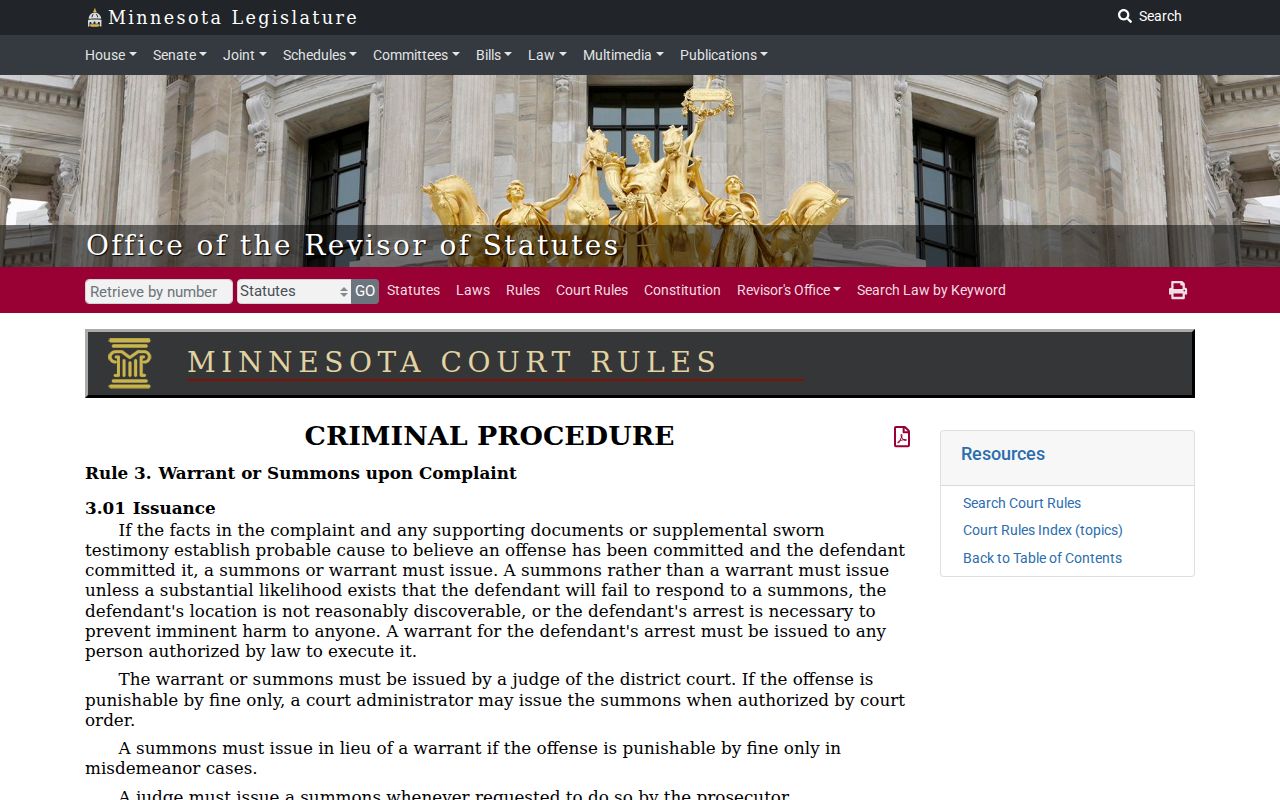
In Carlton County District Court, Rule 3 governs what the warrant must contain and how officers execute it.
How Carlton County Bench Warrants Are Issued
The paperwork starts with a district court judge. No municipal court or justice-of-the-peace layer in Carlton County issues a separate warrant, and no city here publishes its own bench-warrant list. The order itself names the defendant, describes the offense, and states the bail amount and any release conditions. It also directs that the person be brought before the court promptly. Court Administration logs the issuance. That entry is what the public case search displays. Issuing and serving are two different steps. The judge creates the warrant. The Carlton County Sheriff or an authorized city officer carries it out. That gap matters, because a bench warrant can sit active in the court file long before anyone has been stopped.
Release Violations Under Minnesota Rule 6.03
A missed hearing is the familiar route to a warrant, but not the only one. Minnesota Rule 6.03 covers what happens when a person on release breaks a condition. A warrant may issue if the court finds a substantial likelihood the person will not respond, a danger to the public, or a location that cannot reasonably be found. That detail matters for people who never missed a date. Someone on release conditions in Carlton County can pick up a warrant simply by ignoring one of them, and the order may carry arrest authority. Either way, ask Court Administration the same three questions. Is the warrant active? Does it authorize arrest? And what appearance or condition comes next?
Bench Warrants and Arrest Warrants Compared
Bench warrant and arrest warrant mark different moments in a case, though people swap the labels freely. A bench warrant comes later. It answers something that happened after the case began. An arrest warrant usually starts the case, once a judge finds probable cause on a complaint, and that split shows in any Carlton County court file.
| Point | Bench or FTA warrant | Arrest warrant |
|---|---|---|
| Typical trigger | Missed appearance, missed obligation, or release violation | Probable cause on a new complaint |
| Who issues it | Judge handling the existing case | District court judge at charging |
| Arrest authority | Usually, unless it is sign-and-release | Yes |
| Bail | Set in the order when the court requires it | Set in the warrant |
| Local route | Court Administration confirms the status | Court Administration confirms the status |
Minnesota's sign-and-release category cuts across both columns. It counts as a warrant, but in the situations the statute defines it does not authorize arrest.
Bench Warrant Versus Sign-and-Release
Minnesota Statutes 629.415 builds a narrow option for certain misdemeanor and gross-misdemeanor cases. It applies when a mailed summons comes back undeliverable. The warrant it creates does not authorize arrest and sets no bail or other release conditions. Action is still required, though. When an officer encounters the person, the officer hands over written notice of a new appearance date and releases the person at the scene. A signature can be requested. It cannot be required. The Carlton County sheriff and the court then inactivate the warrant. Read the statute beside the Carlton County case record so the label and the effect line up. Minnesota Statutes 629.415, sign-and-release warrant sets out the whole scheme.
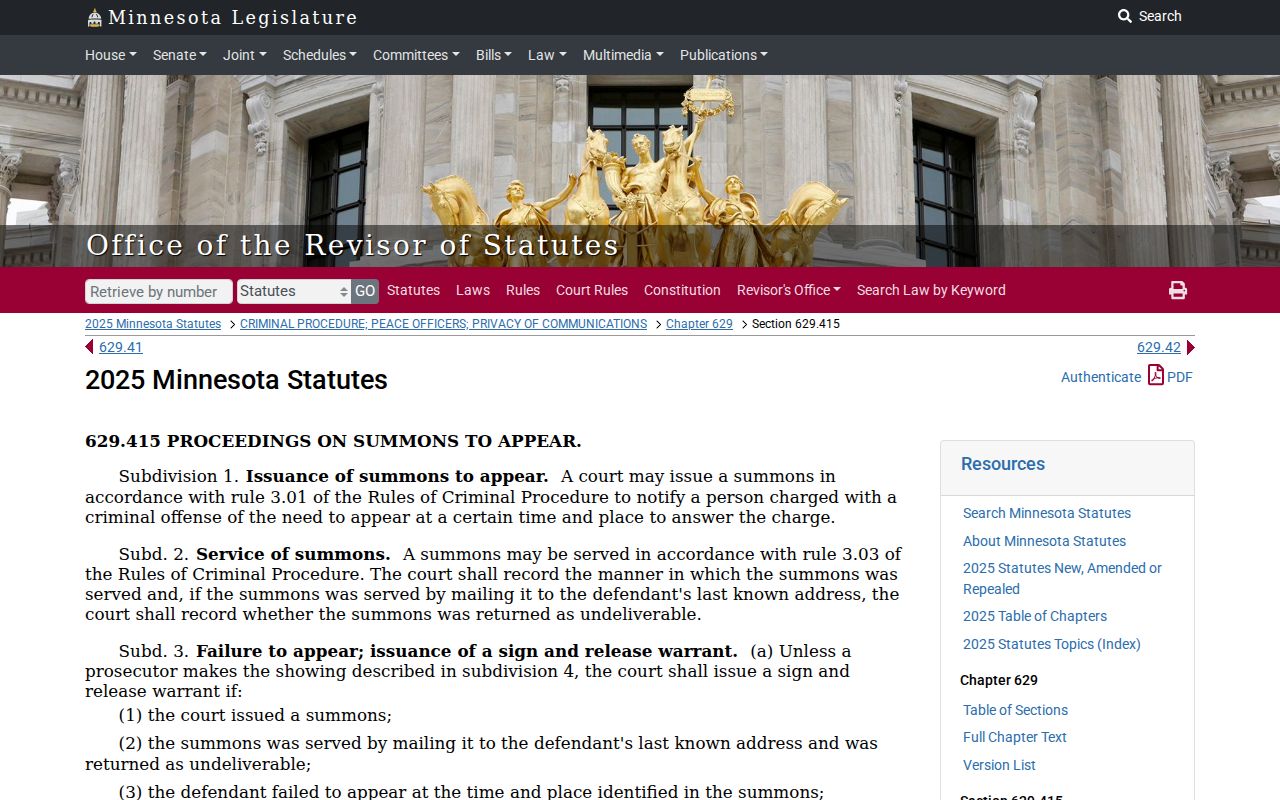
That arrest question is the single most useful thing to ask about any Carlton County bench warrant.
No Carlton County Capias Portal Was Located
Carlton County does not use the word capias. Sites from other states throw the term around, sometimes as capias pro fine. Local court pages say warrant, warrant status, failure to appear, and sign-and-release warrant. The vocabulary gap matters. A warrant search built around a word the Carlton County court never uses will miss the right record. A template that inserts capias also misdescribes Minnesota procedure. Use the terms printed on the case papers. Fine collection works the same way. Carlton County publishes no separate fine-collection writ portal, no recall motion form, and no fee schedule, so both gaps point readers back to Court Administration.
The Court Date You Need to Ask For
One call settles the timing. Carlton County answers directly for a ticket in warrant status, and the same call covers most bench warrants. Ask Court Administration for a date and time to appear, then take the steps in order.
- Gather the legal name, date of birth, case or citation number, and the date you missed.
- Call 218-673-5064 and ask for the warrant type and the next available appearance.
- Ask whether the warrant authorizes arrest before you travel anywhere.
- Ask what payment, if any, is accepted and which office takes it.
- Consult an attorney if the warrant is arrest-authorizing or the case is unclear.
- After the appearance, confirm that the warrant was inactivated in the case record.
The Carlton County traffic warrant search covers the ticket-specific version of this call. The Carlton County FAQ publishes the same warrant-information instruction.
Where Bond Fits in Bench-Warrant Resolution
Bond gets you released, not resolved. If the court sets bail, the Carlton County Jail takes cash or credit-card bail at any time. Call the front window before you come. After a first appearance during business hours, pay at the Court Administrator's Office instead.
| Who sets the amount | The court, in the warrant or a later order. No Carlton County bond schedule by offense is published. |
|---|---|
| Where to pay | Carlton County Jail, Suite 1200, for custody and bail. Call 218-384-4560 first. |
| Accepted payment | Cash or credit card. Personal checks are not accepted. |
| What bond does not do | It does not dismiss the case, restore a license, or end release conditions. |
Keep the receipt and the next court date. Posting bond changes custody, and the Carlton County case still moves forward. Payment details are on the county's Bail and Bonds page.
Resolving a Carlton County Bench Warrant
Resolution runs through the court, usually on a schedule. Call Court Administration first. Learn the warrant type and the next date. Appear as directed, and follow any condition the judge sets. A lawyer can arrange the appearance and prepare a motion to recall a Carlton County bench warrant or to fix a wrong record. Two beliefs cause trouble. Paying a fine does not clear a warrant by itself, and requesting a hearing does not inactivate the order.
Caution: A scheduled hearing does not inactivate a bench warrant. Only the court's action ends it, so confirm the status after every appearance.
The Carlton County warrant records home page lays out the whole sequence, including attorney help, court appearance, and bond options.